- This article contains affiliate links. I may receive a commission if you purchase from them, at no extra cost to you.
Just a few steps away from Rome’s busiest streets, I found complete silence. No crowds, no signs—just ancient cobblestones, soft golden light, and a forgotten fountain hidden in a quiet courtyard.
That moment changed how I see Rome. The city’s true magic isn’t always in its famous squares, but in the secret corners most visitors never notice.
This guide is for travelers who crave a different kind of Rome. If your Rome photo ideas lean toward empty, atmospheric scenes rather than packed landmarks, these 10 hidden spots will show you a quieter, more unforgettable side of the Eternal City.
Table of contents ⇅
10. The Aventine Keyhole (Il Buco della Serratura)
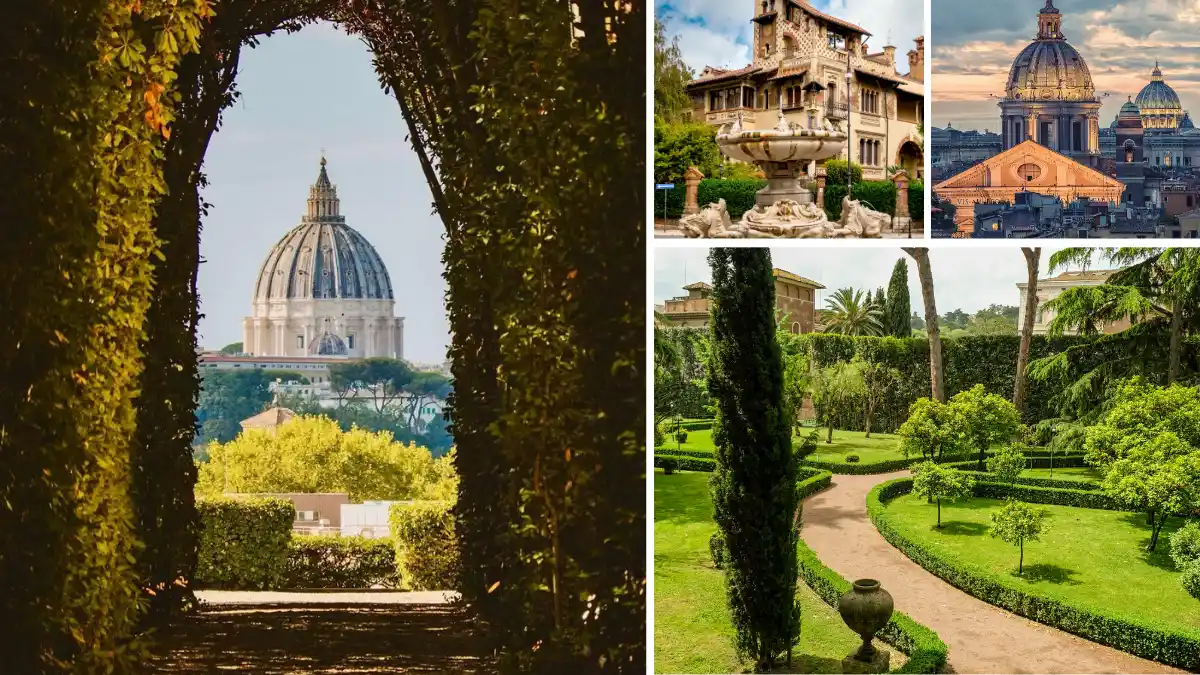
Let’s start with a secret that feels like a magic trick. On the peaceful Aventine Hill, one of Rome’s seven historic hills, you’ll find the unassuming Priory of the Knights of Malta. Its large green door is always locked. But there, at eye level, is a humble keyhole.
Peek through it. This is where you’ll capture one of the most iconic and unique Rome Photography shots.
Your gaze travels down a manicured hedge-lined path, through the keyhole’s perfect frame, and lands directly on the flawless, distant dome of St. Peter’s Basilica. It’s a lesson in forced perspective that never fails to elicit a quiet gasp.
Why it’s a hidden gem:
While known to some, its specific location and the sheer patience required (there’s often a short, quiet line) mean it escapes the massive tour groups.
The hill itself offers a respite from the chaos, with stunning views over the city and an atmosphere that defines the quieter side of the Rome, Italy Aesthetic.
9. The Quartiere Coppedè
Tucked away near the Trieste district, stepping into the Quartiere Coppedè is like stumbling into a fever dream of an architect. It’s not an ancient relic, but a stunning early 20th-century fantasia.
Architect Gino Coppedè fused Art Nouveau, Gothic, Baroque, and even ancient Greek motifs into a residential square and its connecting streets.

You’ll find yourself craning your neck at bizarre sculptures: giant frogs, staring fairies, intricate wrought-iron spider webs, and buildings that look like they belong in a surrealist painting.
The central arch, connecting two buildings, is a masterpiece of eclectic detail. It’s a world away from the classical imagery you associate with Roman Italy.
Why it’s a hidden gem:
Most itineraries have zero room for a 20th-century architectural oddity. You’ll likely have the place to yourself, save for a few architecture students sketching in corners. It’s a testament to the fact that Rome is a living, layered city that never stopped creating.
The lighting here is tricky with deep shadows and bright surfaces. A good travel tripod like this compact carbon fiber model is perfect for getting sharp shots of the incredible details.
8. The Protestant Cemetery (Cimitero Acattolico)
A place of profound peace and melancholy beauty, the Non-Catholic Cemetery near the Pyramid of Cestius is one of the most atmospheric spots in all of Rome. Dappled sunlight filters through cypress trees onto weathered tombstones adorned with poems in English, German, and Russian.
It’s the final resting place of the poets John Keats and Percy Bysshe Shelley, as well as many other non-Catholic artists and diplomats.
The vibe here is pure, contemplative Roma Aesthetic. It’s not grim; it’s beautiful, literary, and serene. Cats, the unofficial guardians of the cemetery, lounge on sun-warmed marble, adding to the timeless feel.
The view of the ancient Roman pyramid just over the wall is an unforgettable juxtaposition of histories.




Why it’s a hidden gem:
Death and cemeteries aren’t on the typical tourist trail. Those who do seek it out are rewarded with what feels like a secret garden of stone and memory. It offers a completely different, reflective perspective on the eternal city.
7. Villa Farnesina in Trastevere
While everyone fights the crowds at the Vatican Museums, art lovers can have a Renaissance masterpiece almost to themselves just across the river in Trastevere.
Villa Farnesina is a stunning Renaissance villa built for a wealthy Sienese banker. Its claim to fame? Breathtaking frescoes by Raphael.

The Loggia of Galatea, featuring his famous Triumph of Galatea, and the Loggia of Cupid and Psyche will leave you speechless. The detail, color, and sheer beauty are on par with the Sistine Chapel, but you can enjoy them in quiet, intimate silence.
The villa itself, with its elegant rooms and lovely garden, embodies the refined Italian Aesthetic of the High Renaissance.
Why it’s a hidden gem:
Its location in lovely Trastevere and its specialization (it’s essentially one glorious house, not a massive museum) keep the crowds at bay. It’s a concentrated dose of genius without the fatigue.
Personal Anecdote:
I sat alone for twenty minutes in the room with Raphael’s Galatea. The only sound was the rustle of the caretaker turning a page of her book. That kind of uninterrupted communion with art is impossible at the Vatican.
6. The Appian Way Catacombs & Countryside (Via Appia Antica)
Yes, the Catacombs of San Callisto or San Sebastiano are known, but most visitors take a rushed tour and leave. The true hidden gem is renting a bicycle and exploring the ancient Via Appia Antica itself on a Sunday, when the main stretch is closed to traffic.

You’ll pedal past crumbling Roman tombs, under ancient aqueducts stretching across green fields, and alongside pine trees that have stood for centuries.
The Rome vibes here are entirely different—rural, historical, and deeply peaceful. You can stop at the Circus of Maxentius, an incredibly preserved ancient chariot racing stadium that sits eerily empty. This is the Rome of poets and painters, the landscape that inspired the Grand Tour artists.
Why it’s a hidden gem:
The experience of being on the ancient road, under your own power, transforms it from a site to see into a journey to feel. It connects you physically to the scale and history of the Roman Empire in a way a bus tour never can.
A comfortable hydration backpack like this one from Osprey is perfect for a day of cycling under the Roman sun.
5. Palazzo Doria Pamphilj
Nestled on the bustling Via del Corso, this is perhaps the greatest art collection in Rome that no one seems to visit. The Palazzo Doria Pamphilj is still a private residence of the noble family, and it feels like it.
The galleries are opulent, filled with velvet drapes, chandeliers, and floor-to-ceiling masterpieces.
You’ll walk through room after room containing works by Caravaggio, Titian, Raphael, and Velázquez (including his stunning portrait of Innocent X).
The audio guide, narrated personally by the current prince, Jonathan Doria Pamphilj, is charming and feels like a private tour. The mirrored ballroom alone is worth the price of admission.
Don’t Miss Out

Why it’s a hidden gem:
It’s overshadowed by the Galleria Borghese (which requires a strict reservation) and the overcrowded Capitoline Museums. Here, you can wander freely, with space to actually stand and stare.
4. The Janiculum Hill (Gianicolo) at Night
The Janiculum Hill is known for its noon cannon blast and panoramic daytime views. But its secret identity emerges after dark. When the sun sets, the tour buses leave. What remains is a quiet terrace overlooking the eternal city, now twinkling with a million lights.

You can see the entire dome of St. Peter’s, the Altare della Patria, and the distant hills illuminated. The Rome, Italy, aesthetic here at night is pure romance and grandeur.
It’s a favorite spot for locals on dates or for a quiet, post-dinner passeggiata (evening stroll). The silence is broken only by the distant hum of the city—a view of Rome that feels both majestic and intimately yours.
Why it’s a hidden gem:
Almost no tourist thinks of coming back here at night. It offers a completely different, and arguably more magical, perspective than the daytime view.
3. San Clemente Basilica
This church, located between the Colosseum and the Lateran, is a physical timeline of Rome. It’s a “lasagna” of history. You enter a beautiful 12th-century basilica with glittering mosaics.
Then, you descend a staircase into a dimly lit 4th-century early Christian church, its frescoes faded but haunting.
But the journey isn’t over. Go down another level. Here, in the cool, damp air, you stand in a 1st-century Roman street, next to the ruins of a Mithraeum (a temple to the god Mithras) and hear the rushing of an ancient underground river.
The sense of peeling back layers of time is unparalleled in Rome, or perhaps in any of the world’s European cities.
Why it’s a hidden gem:
While somewhat known, many are deterred by the small entrance fee for the lower levels. Do not skip it. This is the most literal and powerful hidden gem on the list—a city buried beneath a city.
2. The Mouth of Truth Area at Dusk (Bocca della Verità)
Everyone knows the Bocca della Verità (The Mouth of Truth) from Roman Holiday. Tourists line up for hours to stick their hands in the marble face. The hidden gem isn’t the mouth itself, but the entire, magical area surrounding it at dusk.

Come just before closing time for the mouth (the queue will be gone), then stay. The church of Santa Maria in Cosmedin, which houses the mouth, is a sublime example of Romanesque architecture, with a serene, quiet interior and a beautifully proportioned bell tower.
As the sun sets, the light bathes the little piazza and the two elegant Roman temples next to it—the Temple of Hercules and the Temple of Portunus—in a warm, golden glow. The Rome vibes here are ancient and deeply atmospheric, without the carnival-like feeling of the daytime.
Why it’s a hidden gem:
People treat it as a 5-minute photo op. By lingering, you claim the entire sacred, ancient complex as your own private viewing platform.
1. The Orange Garden on the Aventine… (Giardino degli Aranci)
I mentioned this garden briefly with the keyhole, but it deserves its own top spot for the purest experience. While the keyhole provides a framed view, the Orange Garden offers the grand, sweeping panorama. But go at 8 AM on a Tuesday.
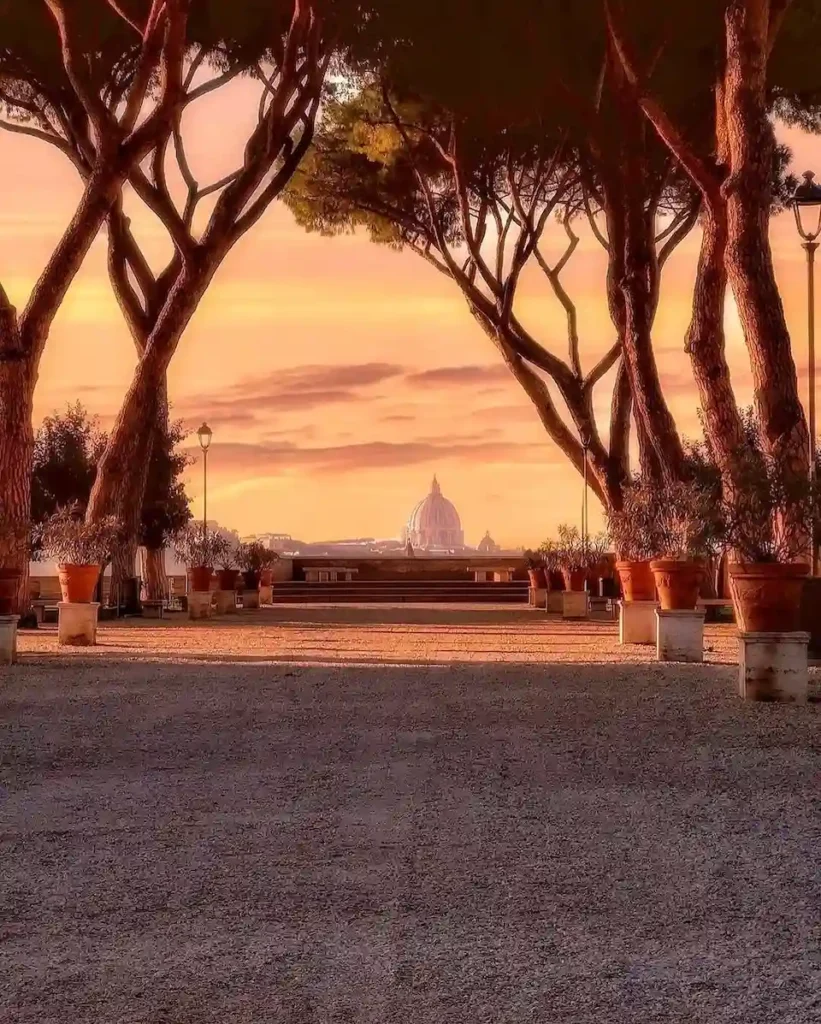
You’ll share the space with perhaps a local jogger and an old man reading a newspaper on a bench. The scent of blooming orange trees (or bitter oranges, depending on the season) fills the air. You can sit on the iconic wall and look out at a sea of terracotta rooftops, domes, and bell towers, with St. Peter’s standing proudly in the distance.
The silence is profound. This is the Rome of your dreams—eternal, beautiful, and serene. It is the absolute pinnacle of the Rome,e Italy Aesthetic and the perfect place to generate authentic Rome Photo Ideas without a soul in your shot.
Why it’s the #1 hidden gem:
Its location is no secret, but timing is everything. By arriving early on a weekday, you transform a popular viewpoint into a personal meditation. It encapsulates the entire lesson of this list: with a little strategy and a willingness to wander, you can find the soul of Rome in its quiet moments.
Personal Anecdote:
This is where I go to remember why I fell in love with Rome. On one such morning, a stray cat hopped up on the wall beside me and sat, also looking out at the view. We shared five minutes of perfect, silent companionship, watching the city wake up. That’s the magic you can’t buy a ticket for.
Comparative Overview: What Makes These Spots Special
Each of these places offers a different kind of “hidden” experience. Some are physically secret (the keyhole, Coppedè), some are temporarily deserted (the Janiculum at night, the Orange Garden at dawn), and others are overlooked due to their niche nature (the Protestant Cemetery, Villa Farnesina).
Don’t Miss Out

What unites them is their ability to provide an experience, not just a sight. They engage different senses: the smell of oranges, the silence of a cemetery, the tactile coolness of a catacomb, the surreal visual of Coppedè, the layered discovery of San Clemente.
They stand in stark contrast to the often overwhelming, transactional nature of visiting the Trevi Fountain or the Colosseum. Here, you aren’t a spectator in a crowd; you are an explorer, a discoverer.
How These Places Changed My Perspective on Rome
Before I found these spots, I saw Rome as a magnificent museum—beautiful but slightly intimidating, a checklist to complete. Discovering its hidden layers taught me that Rome is a living, breathing puzzle.
The joy isn’t just in seeing the famous pieces, but in finding how the smaller, forgotten ones fit together to create a richer picture.

It shifted my travel style from goal-oriented to drift-oriented. I learned to schedule one “big thing” a day and leave the rest to curiosity. This is how you find the unmarked medieval church with a Caravaggio, the tiny trattoria with the perfect cacio e pepe, the courtyard with the whispering fountain.
These secret spots gave me a sense of ownership over my experience of Rome. I wasn’t just following a path; I was making my own.
Practical Recommendations for Your Trip
- Beat the Clock (or Join It): For the outdoor spots (Orange Garden, Keyhole, Janiculum), either go very early or at dusk/night. For indoor spots (Villa Farnesina, Doria Pamphilj), aim for opening time or the last entry slot.
- Get a Transportation Pass: Many of these are spread out. A 72-hour Roma Pass or simple transit ticket is invaluable for hopping on a tram or bus. The #8 tram, for instance, is a scenic ride to Trastevere and beyond.
- Walk with Purpose, But Get Lost: Set one of these gems as your destination, but don’t be afraid to put your phone away for the last 15 minutes of the journey. The best connections in Rome are made on foot, down alleys not on any map.
- Book in Advance Where Needed: While these aren’t the Colosseum, some (like the Catacombs or a specific time slot for Villa Farnesina) benefit from or require a pre-purchased ticket.
- Embrace the Siesta: Many smaller churches and sites close in the early afternoon. Use this time for a long, leisurely lunch like the Romans do.
Product Recommendation: A good pair of walking shoes is non-negotiable. For men and women, a stylish yet supportive walking shoe like these from Ecco can save your feet without sacrificing style on the cobblestones. For your gear, a secure, anti-theft travel backpack like this Pacsafe model offers peace of mind while you explore.
Rome’s greatest gift to the thoughtful traveler is its depth. Behind the roar of Vespas and the queues for gelato lies a city of infinite layers, waiting to be uncovered one secret at a time. This list is just a starting point—a key to a door you must open yourself.
Seek out the quiet, the odd, the overlooked. Let yourself be surprised. Because the true heart of Rome doesn’t always beat loudest in its famous squares; sometimes, it’s a faint, steady pulse in a hidden courtyard, waiting for you to stop, listen, and discover that you’ve found something truly your own. Your own hidden Rome awaits. Now, go and find it.