- This article contains affiliate links. I may receive a commission if you purchase from them, at no extra cost to you.
The first time someone told me Texas had landscapes that could compete with the national parks out west, I nodded politely and didn’t believe them. Then I spent a week driving from Big Bend to the Hill Country, and I’ve been apologizing ever since. Texas is absurdly vast—you can drive twelve hours and still be in the same state—and that size means diversity most people never expect.
Mountains that rise from desert floor. Springs that pour out of limestone cliffs. Canyons carved by rivers that feel like their own private worlds. The best part? Many of these places cost next to nothing to experience. These eight texas destinations prove you don’t need a big budget to get big views.
Table of contents ⇅
Before You Hit the Road: The Texas Reality Check
Distance is Real: Texas is roughly the size of France. The drive between destinations can be four to eight hours. That’s not a flaw—it’s part of the experience. The landscapes between places are often as stunning as the destinations themselves. Plan for travel days, download podcasts, and embrace the road trip rhythm.
The Seasons:
-
Spring (March-May): Wildflowers. Bluebonnets carpet the Hill Country. Perfect temperatures. This is Texas at its most photogenic.
-
Fall (September-November): Similar to spring, with fewer wildflowers but equally pleasant weather. The state fair happens in Dallas/Fort Worth.
-
Summer (June-August): Hot. Sometimes brutally hot. But early mornings and late evenings are still magical. Air conditioning is not optional.
-
Winter (December-February): Mild in most places, cold in the Panhandle. Great for avoiding crowds. Big Bend is actually pleasant in winter.
Staying Connected: Once you leave the interstate, cell service gets spotty. Texas is big, and the towers are far apart. That’s where Saily comes in handy—a reliable eSIM means you’re not hunting for Wi-Fi when you need to find that last-mile dirt road or check if the local diner is still open.

Set it up before you leave, and spend your time looking at canyons, not your phone.
1. Big Bend National Park
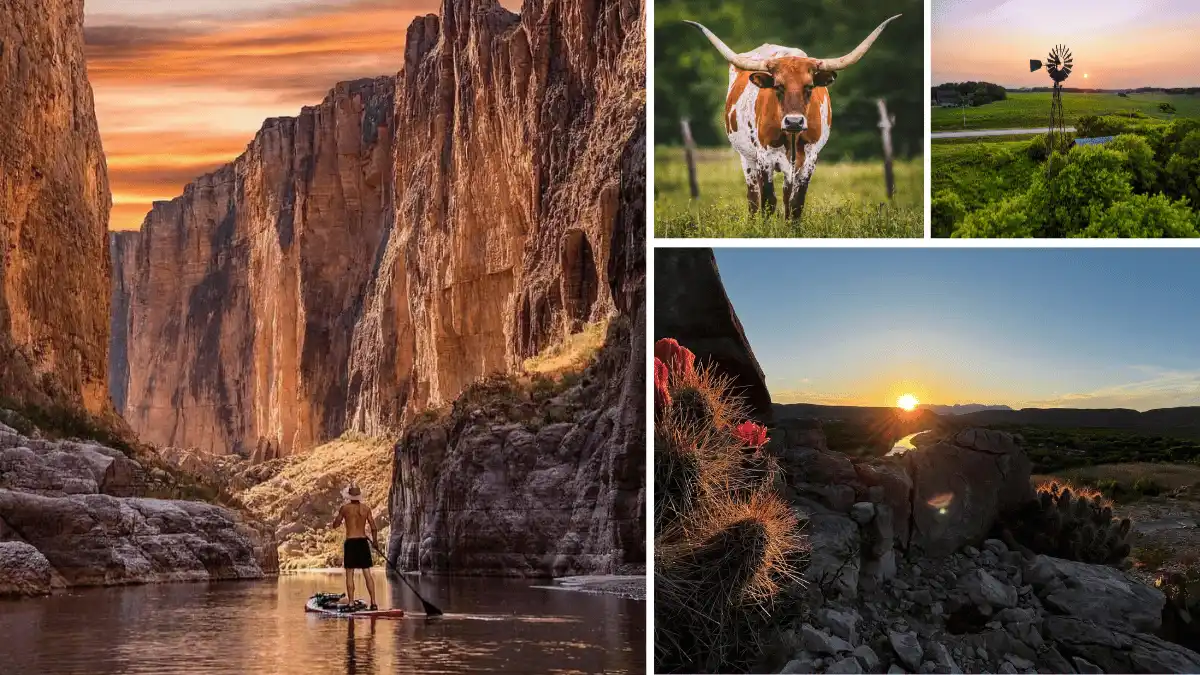
Big Bend is the least-visited national park in the lower 48, and I’ve never understood why. It has everything: mountains that catch the sunrise, a river that forms a natural border, desert that blooms with color after rain, and night skies so dark you can see the Milky Way like a photograph.
The Budget Reality:
Entry fee is $30 per vehicle for 7 days. That’s it. Camping inside the park is $12-16 per night. If you want a room, basic lodging starts around $120 in nearby Terlingua. Compare that to Yellowstone or Zion, and you’re paying a fraction.
What to Do:
- The Window Trail: A 5.6-mile round trip that ends at a pour-off where water cascades through a narrow canyon. Start early—the trail is exposed on the return.
- Santa Elena Canyon: A 1.6-mile trail that takes you into a canyon with walls rising 1,500 feet. The Rio Grande bends through it, and on the other side is Mexico. You can wade across if you want (legally, bring your passport).
- The Ross Maxwell Scenic Drive: A 30-mile road that hits all the park’s highlights. Stop at every pullout. Sotol Vista Overlook at sunset is unforgettable.
- Hot Springs Historic District: Ruins of an old bathhouse with a pool that stays 105°F year-round. The Rio Grande is right there—hot spring on one side, cold river on the other. Perfect.
The best time to see wildlife is dawn and dusk. Javelinas, roadrunners, and the occasional mountain lion are out then. Bring binoculars.
Insider Tip
Where to Stay:
- Budget: Camp inside the park. Chisos Basin Campground has the best setting, under the mountains. Reserve ahead.
- Mid-Range: Terlingua. The ghost town has quirky rentals, casitas, and a few small hotels. The vibe is pure desert weird.
- Splurge: Lajitas Golf Resort. About an hour from the park, but it’s an actual resort with a pool and restaurant. Worth it for the air conditioning in summer.
2. Marfa and the Chinati Mountains
Marfa is famous for the art, the mystery lights, and the fact that it exists in the middle of nowhere. But the landscape surrounding it—the Chinati Mountains, the vast Chihuahuan Desert—is the real draw. And the art? It’s mostly free.
The Budget Reality:
The Chinati Foundation (the big art museum) costs $15-20 for a tour. The outdoor installations are free to walk around. Lodging in Marfa can be expensive, but staying in nearby Alpine or Fort Davis cuts costs significantly.
What to Do:
- The Prada Marfa: A permanent art installation 40 minutes outside town. It’s a fake storefront in the middle of the desert. It’s silly, it’s famous, and it’s free.
- Chinati Foundation: If you go to one museum, make it this one. Donald Judd’s concrete boxes in old military buildings are meditative. The tour takes several hours—book ahead.
- The Marfa Lights: At dusk, drive east on Highway 90 to the viewing station. The lights are unexplained orbs that appear on the horizon. Real? Atmospheric phenomenon? Doesn’t matter. It’s a ritual.
- Fort Davis National Historic Site: 20 minutes north. A preserved frontier fort with mountain views. Entry is $10, and the setting is gorgeous.
The McDonald Observatory is 30 minutes from Marfa. Their star parties are $15-25 and worth every cent. You’ll see Saturn’s rings through professional telescopes.
Insider Tip
Where to Stay:
- Budget: Camp at Davis Mountains State Park. Sites are $20-25, and you’re in the mountains.
- Mid-Range: Alpine. The Holland Hotel is historic, comfortable, and a fraction of Marfa prices.
- Splurge: El Cosmico in Marfa. Vintage trailers, yurts, and tents. It’s an experience more than a hotel.
3. Palo Duro Canyon: The Grand Canyon of Texas
Texas’s second-largest canyon (after Big Bend’s Santa Elena) is a shock. You drive across flat, scrubby Panhandle plains, and suddenly the earth opens into a Technicolor gash of red rock, juniper, and cottonwood. It’s 120 miles long, up to 20 miles wide, and 800 feet deep.
The Budget Reality:
State park entry is $8 per adult. Camping is $16-25 per night. There’s a small amphitheater with a musical drama in summer that’s cheesy and wonderful—tickets around $20. That’s it.
What to Do:
- Lighthouse Trail: The most famous hike in the canyon. 5.8 miles round trip to a rock formation that looks like, well, a lighthouse. The trail is easy until the last scramble. Go early—the sun bakes the trail.
- The Rock Garden Trail: Shorter, steeper, with less traffic. Ends at a viewpoint that gives you the canyon’s scale.
- Drive the Canyon: The park road runs along the canyon floor for several miles. Stop at every pullout. The light changes everything.
- The Palo Duro Trading Post: Historic lodge with a restaurant. The burgers are fine. The history is better.
Where to Stay:
- Budget: Camp inside the park. Sites have water and electricity. Reserve ahead—they fill up.
- Mid-Range: Stay in Canyon, the town 15 minutes away. Basic chain hotels, clean and affordable.
- Unique: The Palo Duro Cabins. Private, rustic, right at the park entrance.
4. Fredericksburg and the Hill Country

The Texas Hill Country is where the state gets pretty. Rolling hills, spring-fed rivers, wildflowers in spring, and a German-infused culture that dates back to the 1840s. Fredericksburg is the hub, but the real magic is in the landscape around it.
The Budget Reality:
Wine tasting here is cheaper than Napa or Sonoma—$10-15 per tasting, sometimes waived with purchase. State parks cost $7 per adult. The town itself is walkable and free to explore.
What to Do:
- Enchanted Rock State Natural Area: A massive pink granite dome that rises from the Hill Country. The hike to the top is short and steep. At the summit, you have 360-degree views of Texas that feel infinite. Entry is $7 per adult. Go early—they close the park when it fills.
- The Willow City Loop: A 13-mile scenic drive that’s free, public, and spectacular. In spring, bluebonnets carpet the roadsides. Year-round, it’s classic Hill Country.
- Main Street Fredericksburg: German architecture, small shops, bakeries selling streusel. Walk it, don’t drive. The Nimitz Museum (part of the National Museum of the Pacific War) is excellent and surprisingly moving.
- The LBJ Ranch: Lyndon Johnson’s “Texas White House” is a national park. Free entry. You can tour the ranch, see the airplane hangar, and understand why LBJ loved this place so much.
Where to Stay:
- Budget: Camp at Enchanted Rock. The sites are basic and fill up fast. Book months ahead.
- Mid-Range: Fredericksburg has dozens of bed and breakfasts. The smaller ones, further from Main Street, are more affordable.
- Splurge: A cabin rental on the outskirts of town. Private, quiet, and often cheaper than a hotel during peak season.
Insider Tip: The Hill Country is wine country. Tours can get expensive, but you can DIY: buy a bottle from a winery, find a scenic overlook, and have your own tasting with a view. The land is what makes the wine special anyway.
5. Guadalupe Mountains National Park
Most people drive past this park on their way to Carlsbad Caverns. They shouldn’t. The Guadalupe Mountains hold Texas’s highest peak (Guadalupe Peak, 8,751 feet), a fossil reef that’s been dead for 250 million years, and some of the most dramatic hiking in the state.
The Budget Reality:
Entry is free. Yes, free. Camping is $15-20 per night. There’s no lodging inside the park, so staying in nearby towns is the only option, and those are affordable.
What to Do:
- Guadalupe Peak Trail: The summit hike is 8.4 miles round trip with 3,000 feet of elevation gain. It’s strenuous, but the view from the top of Texas is worth every step. The trail is well-marked. Start early.
- McKittrick Canyon: A gentler option. The trail follows a spring-fed creek through a canyon that explodes with color in autumn. It’s one of the most beautiful places in Texas, and almost no one goes.
- The Frijole Ranch: A historic ranch house with a small museum. The spring-fed pool out front is where animals drink at dusk—bring binoculars.
Where to Stay:
- Budget: Camp at Pine Springs Campground inside the park. It’s basic but you’re right at the trailhead.
- Mid-Range: Stay in Carlsbad, New Mexico, 30 minutes north. Lots of chain hotels, restaurants, and cheaper than anything in Texas.
- Alternative: Van Horn is an hour south, with more options and a quirky downtown.
Insider Tip: The park has no cell service. None. Download offline maps before you arrive. The rangers are helpful but the visitor center closes early. Plan ahead.
6. South Padre Island
Yes, South Padre is famous for spring break. But outside of March, it’s a quiet barrier island with 34 miles of beach, excellent birding, and a state park that feels like a different world. The water is warm, the sunsets are long, and the prices are reasonable if you know where to look.
The Budget Reality:
Beach access is free. State park entry is $7 per adult. Lodging in summer is expensive, but shoulder season (April-May, September-October) drops significantly. You can also stay in nearby Port Isabel, which is cheaper and connected by bridge.
What to Do:
- South Padre Island Birding and Nature Center: A boardwalk through wetlands with viewing towers. You’ll see spoonbills, egrets, and sometimes alligators. Entry is $7.
- Sea Turtle Inc. : A rescue center that rehabilitates injured sea turtles. You can watch feedings and learn about conservation. Donation suggested.
- The Beach: The main beach is free. Drive north of the main access points for quieter stretches. You can drive on the beach with a permit ($12 for the day).
- Isla Blanca Park: The county park at the island’s southern tip. Calm water, picnic areas, and a long jetty you can walk out on.
Where to Stay:
- Budget: Camp at Isla Blanca Park. Sites are $20-30 and right on the water.
- Mid-Range: Port Isabel. The lighthouse inn is historic, and the rates are half of what you’d pay on the island.
- Splurge: A condo rental on the island with a kitchen. Cooking your own meals saves money, and the views are worth it.
Insider Tip: Winter is the best time for birding. Thousands of species migrate through the Lower Rio Grande Valley, and the island is a major stop. The crowds are gone, the weather is mild, and the birds are spectacular.
7. Caddo Lake
Caddo Lake is the only naturally formed lake in Texas—the result of a log jam on the Red River that created a sprawling bayou of cypress trees draped in Spanish moss. It looks like Louisiana, feels like a dream, and costs almost nothing to experience.
The Budget Reality:
State park entry is $6 per adult. Kayak rentals are $15-25 per hour. You can camp for $15-20 per night. The real expense is gas to get here—it’s in far northeast Texas, closer to Shreveport than Dallas.
What to Do:
- Caddo Lake State Park: The launch point for exploration. Rent a canoe or kayak and paddle through the cypress forest. The trees are hundreds of years old, the moss hangs like curtains, and the silence is profound.
- Big Cypress Bayou: If you don’t want to paddle, drive the roads around the lake. The scenery is just as beautiful from land.
- Uncertain, Texas: Yes, that’s the name of a town. It has a general store, a cafe, and a post office. Stop for a photo and a snack.
- Jefferson: The historic town nearby is worth a visit. The downtown is preserved, the antique shops are endless, and the riverboat tours are surprisingly charming.
Where to Stay:
- Budget: Camp at Caddo Lake State Park. The campsites are shaded and close to the water.
- Mid-Range: Jefferson. The historic inns and B&Bs are reasonably priced and full of character.
- Unique: Rent a houseboat on the lake. Several companies offer floating cabins. It’s the best way to wake up on the water.
Insider Tip: The cypress trees are best photographed early morning or late afternoon, when the light slants through the moss. Bring bug spray—the swamp means mosquitoes.
Travelpayouts Widget Placement Opportunity:
After this section is a great spot for a hotel search widget. Caddo Lake has limited lodging, and readers will want to check availability in Jefferson or nearby towns before committing to the drive.
8. The Hill Country State Natural Area
Enchanted Rock gets all the attention, but the Hill Country State Natural Area, 20 minutes south, is the quiet alternative. It’s 5,400 acres of ranchland preserved as it was—hills, canyons, spring-fed streams, and trails that go for miles without seeing another person.
The Budget Reality:
Entry is $5 per adult. Camping is $15 per night. That’s it. No gift shop, no visitor center, no frills. Just land.
What to Do:
- The Trails: There are 25 miles of hiking trails and 16 miles of equestrian trails. The Western Trail is the easiest, following a creek. The Hill Country Trail is the hardest, climbing to a ridge with views of the surrounding hills.
- The Springs: The area has several springs that run year-round. In summer, they’re cold enough to cool off in. The water is clear, the pools are natural, and you’ll likely have them to yourself.
- The Ruins: Old ranch buildings, windmills, and fences dot the landscape. They’re reminders that this was working land not that long ago.
Where to Stay:
- Budget: Camp inside the park. The sites are primitive—no water, no electricity—but the night sky is worth it.
- Mid-Range: Stay in Bandera, the “Cowboy Capital of the World.” Motels are cheap, and the local restaurants serve proper Texas breakfast.
- Unique: Book a stay at a working ranch nearby. Several offer guest cabins and meals. It’s not cheap, but it’s the real Texas experience.
Insider Tip: The park is popular with horseback riders. If you don’t have horses, stick to the hiking trails. The horse trails can be muddy and heavily used.
Texas Budget Traveler’s Toolkit
The Texas State Parks Pass:
For $70, you get free entry to all 80+ state parks for a year. If you’re visiting two or more parks on this list, it pays for itself. Buy it at the first park you visit.
The Regional Airports:
Flying into Dallas or Houston is obvious, but consider alternatives:
- El Paso for Big Bend, Guadalupe Mountains
- Midland/Odessa for Marfa, Fort Davis
- San Antonio for Hill Country
- Harlingen for South Padre Island
- Shreveport, LA for Caddo Lake
Smaller airports often have cheaper flights and put you closer to your destination.
The Food Strategy:
Texas is a food state. The best meals are often the cheapest:
- Breakfast tacos: $2-3 each, available everywhere
- Barbecue: $10-15 for a plate that will feed you for the day
- Kolaches: Czech pastries that are Texas’s answer to the croissant. $2-3 each.
- H-E-B: The grocery store. Their prepared food is excellent and a fraction of restaurant prices.
The Texas Nobody Told You About
Texas has a reputation: big hats, bigger trucks, everything larger than life. That version exists. But the Texas that sticks with you is the one that reveals itself slowly—the canyon you didn’t know was there, the spring you stumbled on, the stretch of highway where the sunset turned the sky colors you’ve never seen.
These eight texas destinations are all affordable, accessible, and deeply beautiful. They’re the Texas that Texans keep for themselves. Now you know where to find it.